Showing posts with label Jie Zhou. Show all posts

Thursday, July 28, 2011

Jie Zhou: Summary of Smart Grid Presentation

Summary of Smart Grid Presentation

Jie Zhou
07/28/2011

The Traditional Grid
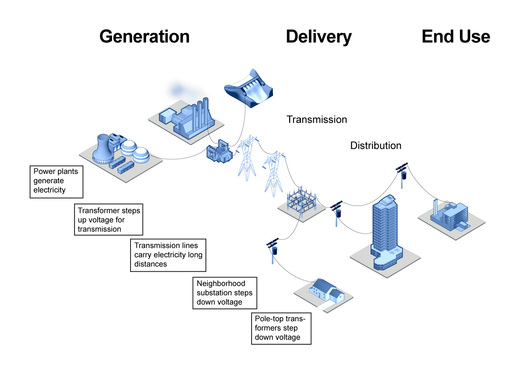

Some problems with the existing grid:
- getting old and worn out
- population growth cause the transmission system overused and gragile
- reliability of the grid decline


Versus the Smart Grid
The most important and distinctive characteristic of the Smart Grid is its "intelligence" and two-way communication capabilities.

Functions

  • Self-healing from power disturbance events
Automatically detects and responds to grid problems, ensuring quick recovery after disturbances. The incorporation of microgrids also means that affected areas can be isolated from the main network as to cause minimal disruption to services,
  • Enabling active participation by consumers in demand response
The development of the smart grid and associatd smart technologies and devices will allow users to have more direct control over the energy they use on a day-to-day basis. Like changing what they need from a power supplier, moving towards flexible energy, cheaper alternatives and the option for microgeneration
  •  Variety of generation options
The current electricity grid cannot integrated well of energy being drawn from a variety of energy sources, like solar, wind turbine, etc. but this is the aim of the smart grid
  • Providing higher quality power that will save money wasted from outage
Assuring more stable electricity, avoiding outages or blackouts to reduce economic loss
  • Accommodating all generation and storage options
All sources will be interconnected allowing consumers to access a general and renewable generated source of energy. Energy that is generated during non-peak timses can be stored for potential usage to ensure minimal wastage.
  • Enabling new products, services, and markets
Creating an open market where alternative energy sources can be sold to customers regardless of location. Microgeneration (like some large networks such as offices) can generate own power through solar panels, wind turbines and in turn can supply energy back to the central net work grid, and make some money on it.
  • Optimizing assets and operating efficiently
Generate more power through the existing systems by optimizing them, allowing the reduction of power flow waste and maximizing the distribution of lower-costgeneration sources.

Major Driving Forces
Obstables

One-half of the utilities surveyed in the recent Pacific Crest Mosaic Smart Grid Survey named rate Cost as the strongest barrier to Smart Grid projects within their organization. Technology immaturity is also a key barrier to Smart Grid projects but is rated a “top” barrier for fewer respondents.

Regulatory Barriers and Lack of Open Standards are some of the other obstacles.


Smart grids by country
Australia
The Australian government has committed to investing $100 m in smart grids. They said they will build the smart grid over five sites in New South Wales
Canada
The government of Ontario, Canada, through the Energy Conservation Responsibility Act [3] in 2006, has mandated the installation of Smart Meters in all Ontario businesses and households by 2010.
China
As part of its current 5-year plan, China is building a Wide Area Monitoring system (WAMS). On May 21, 2009, China has announced an aggressive framework for Smart Grid deployment.
European Union
Development of smart grid technologies is part of the European Technology Platform (ETP) initiative and is called the SmartGrids Technology platform. The SmartGrids Technology Platform began its work in 2005. Its aim is to formulate and promote a vision for the development of European electricity networks looking towards 2020 and beyond
Republic of Korea
On January 2010, the Korean government has launched a $65 million pilot program consists of several programs, one of which is a fully integrated Smart Grid System for 6000 households
The Korean government seeks to complete the installation of smart grid in the country by 2030 and establish another 27,000 or more power charge stations for electric cars. A total of 27.5 trillion won will be injected according to the roadmap.
United States
Support for smart grids became federal policy with passage of the Energy Independence and Security Act of 2007. The law, Title13, sets out $100 million in funding per fiscal year from 2008–2012.
Smart grids received further support with the passage of the American Recovery and Reinvestment Act of 2009, which set aside $11 billion for the creation of a smart grid.


Source:

Wednesday, July 27, 2011

Jie Zhou: Summary of “Dams and Sustainability in China” in Woodrow Wilson Internatinal Center

Summary of “Dams and Sustainability in China” in Woodrow Wilson Internatinal Center

By: Jie Zhou
07/26/2011

This Tuesday the Woodrow Wilson Center Hosted a China Environment Forum on “Dams and Sustainability in China” as China is home to roughly half the world's large dams and hydropower is set to play a key role in helping China meet its 2020 carbon intensity reduction commitments. The speakers explored dam trends and challenges in China,

Speakers

Doug Smith, International Hydropower Association (IHA)
As a Sustainability Specialist at the IHA, Douglas has focused on the new Hydropower Sustainability Assesemtn Protocol. He has experience over twenty countries on four continents, and worked in Beijing for three years until 2010.

Desiree Tullos, Oregon State University
Desiree Tullos is an Associate Professor in the Biological and Ecological Engineering Department at Oregon State University. Some of her current research include effects of hydropower development in China, analysis and design of dam removal, dam operations, etc.. She has been working in China since 2005.

Wang Hao, China Institute for Water Resources and Hydropower Research
Dr. Wang has been engaged in research on hydrology and water resources for 30+ years. He joined China Institute of Water Resources and Hydropower Research in 1985 where he currently directs the Water Resources Department. He has won numerous scienfitic awards and recognition from the Ministry of Water Resources for his research and service to hydrology and water resources science in China.

Key Points

There has long been debate on whether it’s right or wrong to build large amounts of dams. Dr. Wang addressed the necessity at the forum of building dams in China for 4 reasons: national demand, national energy security, and demand of climate change, and natural disster relief.

An estimated population of 1.5 billion by 2020 and the urbanization progress demands large quatity of water and electricity; the existed water shortage in 400+ cities in China largely counted on dams for water supply; Tsunami accident in Fukushima raised great concern on the unpredictable and uncertain nuclear power plants leaning to hydropower plants.

However, there are problems and various issues in dam construction and operation: insufficient attention to imigants; interdiction of fish migration; long-term operation safety. Thus, China faces challenges such as the goal to reduce 40%-45% of CO2 by 2020, to increase storage capacity per capita, and to take better care of immigrants near the water area of dams constructed, etc.

Mr.Doug Smith and the Internatinal Hydropower Association has developed lots of acitivities in China, and been fousing on the Hydropower sustainability Assessment Principal, the frame of hydropower sustainability, which procedures along early stage, preparation, implementation, and operation of dams. Preparation stage, for instance, involves environmental, economic, and social aspects. The case of Shuibuya Trail assessment is one of the successes of the frame.

Ms. Desiree Tullos emphasized the decision support tool, silience, and the size that matters in the design, construction, and operation phases of dams, and said we should integreated biophysical, socioeconomic, and geopolitical axes into these different phases alsong with sustainability priorities.

More information can be found at: http://www.wilsoncenter.org/event/dams-and-sustainability-china

Tuesday, July 19, 2011

Jie Zhou: Heavy Metal Pollution in China

Heavy Metal Pollution in China
In the sense of environmental pollution, heavy metals are described as metals & metalloids which are distinctively toxic to organisms and environment. Cadmium, lead & mercury are commonly cited as being of the greatest public health concern.
China’s 12th 5-year-plan which is passed earlier this year has a concentration on tackling heavy metal pollution. According to the plan, there are 14 provinces and autonomous regions severely polluted by heavy metals, and are critical to take action immediately. Most of them are located in the southern part of China.
There are two origins of heavy metal. Geological background level of heavy metal is low in China. Most of the natural resource contains some sort of heavy metal itself. While generation of heavy metal through human activities is high, causing pollution to air, soil, and water from 3 sources:
Industry emission is the main source of heavy metal pollution in China. The emission of heavy metals is from smelting, coal burning, purification of metals, fuel burning, and tire wear.
Wastewater irrigation is another main source of heavy metal pollution. During the development of mining, zincification, stabilized compounds of dye and plastics, colorants in oil paint and the tire manufacturing industry, they produce tons of wastewater, either merge into rivers, or penetrate soil in farmlands. Wastewater irrigation is very common in China, especially in the northwestern area, where there is a lack of water resources.
The third source of heavy metal is Solid Waste referring to fertilizing sludge, usage of the chemical fertilizer, and agro-chemicals increased heavy metal pollution; wasted electronic equipment also generates emissions of different kind of heavy metal, which harm human health.
A very basic Strategy to prevent public health from heavy metal pollution is to curb the pollution source. The Chinese government has made regulations in controlling the emission of heavy metal. Corporations which have not undergone the related assessment, for example, will be forced to discontinue production until they can meet such requirements.
Controlling and improving contaminated resource is also important. Methods for contaminated soil are in 4 categories: Physical, Biological, Chemical, and Agricultural method.
China’s State Council recently passed the “Twelfth Five-year Plan to Combat Heavy Metal Pollution” requiring that pollution from heavy metal emissions in critical areas be reduced by 15 percent, compared to 2007, by the year 2015. For all other areas, the pollution levels from heavy metal emissions should not exceed the levels reached in 2007.